

Communities across the United States are competing for a rapidly growing form of economic development: data centers.
Artificial intelligence requires extraordinary amounts of computing power, and companies are investing billions of dollars in the infrastructure needed to provide it. For cities and counties, these projects can promise construction activity, tax revenue, and long-term economic investment.
They can also introduce environmental challenges that communities are only beginning to understand.
Water consumption and electricity demand have dominated much of the debate surrounding data-center development. Now another issue deserves attention: PFAS.
Recent research has raised concerns that the growth of artificial intelligence and high-performance computing could increase demand for fluorinated chemicals used in advanced cooling systems and throughout the semiconductor supply chain.
For municipalities considering new data-center projects, this presents an opportunity to learn from decades of PFAS contamination elsewhere.
Instead of discovering contamination years after it occurs, communities can begin asking questions before facilities are constructed.
Why Cooling Has Become Such an Important Data Center Issue
Servers generate heat, and the high-performance processors used for artificial intelligence generate enormous amounts of it.
Keeping that equipment cool is one of the central engineering challenges facing modern data centers.
Traditional facilities often use air cooling or water-based systems. But increasingly powerful computing equipment has encouraged companies to explore liquid-cooling technologies capable of removing heat more efficiently.
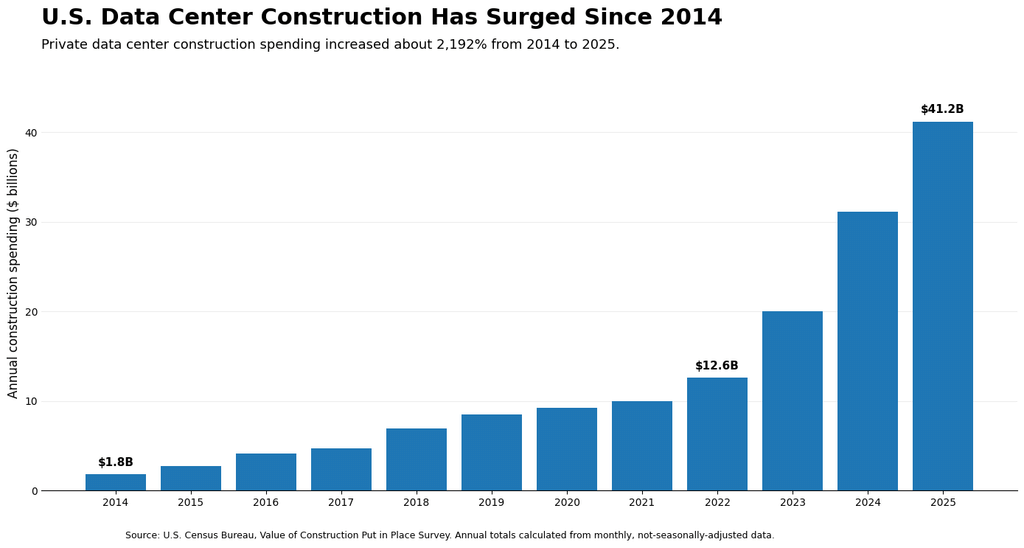
The need to reduce this heat scales as the amount of data centers across the country grows. The scale of that expansion is significant. U.S. Census Bureau construction data show that annual private data center construction spending grew from approximately $1.8 billion in 2014 to more than $41 billion in 2025. As billions of dollars continue flowing into new data center infrastructure, the environmental implications of the technologies used to operate these facilities become increasingly important.
Some advanced systems use fluorinated dielectric fluids.
These chemicals can perform well under extreme operating conditions because they resist heat and chemical degradation.
Unfortunately, persistence is also the defining environmental concern associated with PFAS.
Reducing Water Consumption Should Not Create a Different Environmental Problem
Data centers have already faced criticism for their potential water consumption, particularly in communities experiencing drought or pressure on local water supplies.
That has created a strong incentive to develop cooling systems requiring less water.
Reducing water consumption can be environmentally beneficial.
But communities should be cautious about solving one environmental problem by creating another.
Replacing water-intensive cooling with systems dependent on persistent fluorinated chemicals could create a difficult tradeoff if those chemicals escape during manufacturing, operation, maintenance, or disposal.
Municipalities therefore need to evaluate the complete environmental footprint of proposed cooling technologies rather than looking at water consumption alone.
PFAS Releases Can Affect More Than the Property Where They Originate
Groundwater contamination rarely respects property boundaries.
Chemicals released into soil can migrate through groundwater and potentially reach private wells, municipal drinking-water sources, rivers, wetlands, or neighboring properties.
PFAS compounds are especially concerning because many are highly persistent.
Once contamination occurs, simply eliminating the original source may not solve the problem.
A contaminated groundwater plume can remain long after the facility responsible for the release has changed ownership, replaced its equipment, or ceased operations.
That is why preventing contamination is often far easier than attempting to remediate it decades later.
Data Centers May Have Multiple Chemical Pathways to Consider
Cooling fluids are only one potential piece of the environmental picture.
Researchers examining the chemical footprint of digital infrastructure have identified several areas deserving greater attention, including cooling systems, fire-suppression equipment, refrigerants, cleaning agents, wastewater, and the manufacturing supply chain supporting electronic equipment.
Cooling towers can also produce wastewater known as blowdown as dissolved chemicals become concentrated within circulating water.
That wastewater may eventually enter municipal wastewater systems depending on the facility design.
For municipalities, the important lesson is that environmental review should examine the entire facility rather than focusing exclusively on electricity and water consumption.
What Can Cities and Municipalities Do?
Local governments do not need to wait until contamination occurs to begin managing potential risk.
1. Require Detailed Chemical Disclosure
Municipalities evaluating major data-center developments can request detailed information about the chemicals that will be stored and used on site.
That includes cooling fluids, refrigerants, fire-suppression agents, cleaning products, and other fluorinated chemicals.
Officials should understand not only the trade names of these products but also their chemical composition and whether they contain PFAS.
2. Establish Baseline Water Testing
One of the most valuable steps a community can take is establishing environmental conditions before a facility begins operating.
Baseline sampling of groundwater, nearby surface water, and potentially drinking-water sources can create a record of existing PFAS concentrations.
If contamination is discovered years later, that historical data can become extremely important in determining whether conditions changed after development occurred.
3. Consider Long-Term Monitoring
Testing should not necessarily end when construction is completed.
Periodic monitoring around facilities using significant quantities of fluorinated chemicals could identify changes before contamination becomes widespread.
Monitoring wells placed strategically around a site may help environmental professionals understand groundwater conditions and detect potential migration.
4. Evaluate PFAS-Free Cooling Alternatives
PFAS-based cooling is not the only option available to data-center operators.
Single-phase liquid-cooling technologies and other systems can potentially provide high-performance cooling without relying on PFAS-based dielectric fluids.
Municipalities negotiating development agreements or environmental conditions can ask developers whether PFAS-free alternatives have been evaluated and why a particular cooling technology was selected.
5. Plan for Spills Before They Occur
Facilities using large volumes of chemicals should have clearly defined spill-prevention and emergency-response procedures.
Local fire departments and emergency-management agencies should know what chemicals are present, how releases should be contained, and whether specialized equipment or disposal procedures are necessary.
6. Examine Wastewater and Disposal Plans
Communities should also understand what happens when cooling fluids reach the end of their useful life.
Where will they go?
How will contaminated equipment be handled?
Could wastewater containing fluorinated compounds enter the municipal sewer system?
These questions matter because wastewater treatment plants were generally not designed specifically to remove PFAS.
Preventing PFAS from entering the waste stream can therefore be considerably easier than removing it afterward.
7. Consider the Full Life of the Facility
Data centers will not operate forever.
Municipalities should consider what happens when cooling systems are replaced, a facility is renovated, or a data center eventually closes.
Decommissioning plans can address chemical removal, equipment disposal, environmental testing, and responsibility for contamination discovered after operations cease.
Municipal Water Systems Already Face Growing PFAS Responsibilities
These precautions are especially important because drinking-water utilities are already confronting increased PFAS monitoring and treatment requirements.
EPA’s federal drinking-water standards establish maximum contaminant levels of 4 parts per trillion for PFOA and PFOS.
EPA has proposed allowing qualifying systems additional time to achieve compliance, potentially extending deadlines to 2031, but the underlying standards remain.
For communities, this creates an important financial consideration.
Allowing new sources of persistent contamination into a watershed could eventually increase treatment costs for the same municipal systems responsible for delivering safe drinking water.
Preventing pollution upstream may ultimately be much less expensive than removing it downstream.
Data Center Development Is Moving Faster Than Environmental Policy
This issue is developing within a larger political debate.
Federal, state, and local governments want to attract artificial-intelligence infrastructure because of its economic and strategic importance.
At the same time, communities are asking increasingly difficult questions about energy demand, water consumption, air emissions, infrastructure costs, and environmental impacts.
That tension is already visible in places experiencing rapid data-center growth.
The challenge for municipalities is not necessarily choosing between technological development and environmental protection.
It is ensuring that development occurs with safeguards appropriate for technologies whose environmental consequences may not yet be completely understood.
Communities Have an Opportunity to Avoid Repeating the PFAS Story
Many communities dealing with PFAS contamination today are addressing releases that occurred years or even decades ago.
By the time contamination was discovered, the chemicals had already migrated through groundwater, entered drinking-water supplies, or accumulated in the environment.
Data-center development offers communities an opportunity to approach the problem differently.
Cities can ask what chemicals are being used.
Water systems can establish baseline conditions.
Environmental officials can monitor groundwater.
Developers can evaluate PFAS-free technologies.
Municipalities can establish clear requirements for chemical handling, wastewater, spills, and eventual decommissioning.
The enormous expansion of artificial intelligence infrastructure is only beginning.
The environmental decisions made during this period may shape local water resources for decades.
Communities do not have to wait for contamination to determine how they will respond.
They can begin protecting their groundwater before the first server ever comes online.